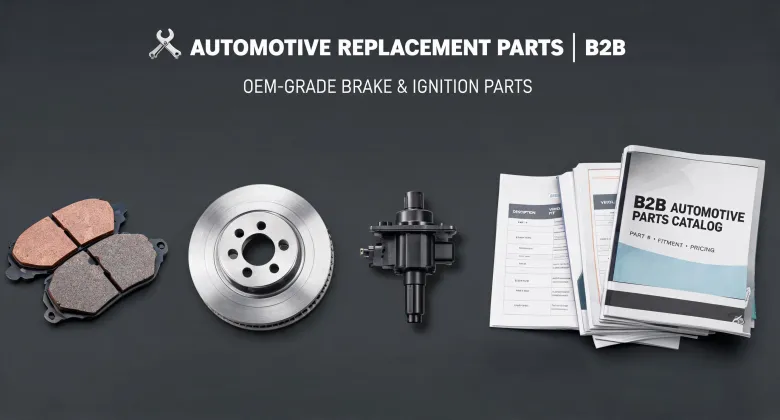
If you're here because you need Bendix brake rotors and a front coil spring for your Silverado, I can help. But if you're hoping to find out how to change a headlight bulb in the same afternoon, let me save you some trouble: you can't, and you shouldn't try to do both at once.
I learned this the hard way. When I first started planning maintenance for our fleet vehicles, I assumed all car parts replenishment was basically the same. You find the part number, you order it, you install it. Simple, right?
Turns out, I couldn't have been more wrong. That naive assumption cost us a $3,200 order and a two-week delay in Q3 2022. Let me walk you through what I now know about the critical difference between high-stakes structural parts like a Silverado front differential and consumable items, and how to plan your purchases to avoid my mistakes.
The Short Version: What's a 'High-Stakes' Part vs. What Isn't
When I say 'high-stakes,' I'm not being dramatic. I'm talking about parts where a failure isn't just an inconvenience—it's a safety hazard. Your Bendix brake rotors and front coil spring are in this category. They are critical to your vehicle's ability to stop and steer. The Silverado front differential? Also in this club. A failure here can leave you stranded and cost thousands in drivetrain damage.
On the flip side, replacing your Silverado's headlight bulb? That's a low-stakes, 15-minute job. It's a wearable item. It doesn't affect the structural integrity of your truck. My mistake was treating the front differential order with the same casual approach as ordering a headlight bulb.
Here's a quick breakdown I now use:
- Safety-Critical & Complex: Bendix brake shoes and rotors, front coil springs, front differentials.
- Wearable & Simple: Headlight bulbs, wiper blades, cabin air filters.
This seems obvious now, but as a rookie, I didn't make the distinction.
Why You Can't 'Just Order' a Silverado Front Differential Like a Headlight Bulb
My biggest single mistake was ordering a Silverado front differential the same way I'd order a headlight bulb. I just looked for the cheapest option on a general auto parts site. It fit, it was cheap, and it was available. What could go wrong?
Everything.
The unit arrived, the install took two days of shop time, and within a week, it started making a noise. The reason? I'd ordered a remanufactured unit from a vendor that didn't specialize in differentials. The tolerances were off.
Here's the core difference I missed: when you order a low-stakes part, the biggest risk is the part being poor quality. When you order a high-stakes part, the biggest risk is your entire vehicle sustaining damage from a poor install or a mismatched part.
- Headlight bulb risk: $20 wasted, 15 minutes of your time.
- Front differential risk: $1,500 wasted, potential transmission damage, 2 days of labor, safety hazard.
The stakes are not the same. The planning shouldn't be either.
My Three Non-Negotiable Rules for Ordering Critical Parts Like Bendix Brakes and Coil Springs
After the front differential debacle, I created a pre-order checklist that I (and my team) follow without exception. It hasn't failed us since. For parts like Bendix brake shoes, front coil springs, and other safety items, here are the rules:
Rule 1: Specialist Over Generalist, Every Time
You can buy a headlight bulb from a gas station. You should not buy a Silverado front differential from a generalist. Sure, a generalist might have the right part number, but do they know the specifics of your vehicle's build? For Bendix brake rotors, I now only go to a specialist that understands the full Bendix product line and its application across different GM and Ford platforms. They can tell you if a rotor is compatible with your specific brake pad compound and driving conditions.
I once ordered Bendix brake shoes from a general truck parts retailer. The box said 'Bendix,' but the shoe geometry was slightly off for our fleet's specific model year. That error cost $890 in redo plus a 1-week delay. The specialist Bendix dealer would have caught that from the VIN.
Rule 2: Verify Fitment from the Source, Not Just a Website
Don't trust the 'fits your vehicle' filter on a retail site. That filter is often based on broad model years, not specific trim levels or optional packages. For a part like a front coil spring, the spring rate varies based on whether your truck has a snow plow prep package, a heavy-duty towing package, or aftermarket bumpers.
My current method: I call the specialist. I give them the VIN. They confirm fitment from the manufacturer's catalog. It takes five minutes and saves a world of pain. I learned this after ordering a set of Bendix rotors that were physically correct but were for a non-towing application. They warped in two months under our fleet load.
Rule 3: Budget a Surge, Not a Squeeze
This was the hardest lesson. When I first started, I tried to 'squeeze' the budget on every part. That's fine for a $20 headlight bulb. For a $1,200 front differential or a $600 set of Bendix brake rotors, it's a terrible idea.
I now budget a 'surge' for critical parts. This means I plan for a price 15-25% higher than the cheapest quote. I use that budget on the specialist vendor who offers a warranty, application engineering support, and faster shipping times. Sound expensive? The time I didn't do this and had to warranty claim a differential lost us $3,200 in parts, labor, and downtime. That was way more than the surge would have cost.
When My Rules Don't Apply: The Headlight Bulb Exception
To be fair, my system breaks down for simple jobs. If you're asking 'how change headlight bulb' for your Silverado, my three rules are overkill. You can get a bulb from any auto parts store, and the fitment is universal. The risk is near zero. The process takes 15 minutes. It's the perfect example of a low-risk part that you can purchase with a 'set it and forget it' approach.
Similarly, if you're buying wiper blades or a cabin filter, the specialist rule doesn't apply. The consequences of a wrong choice are an annoyance, not a safety failure.
But the moment you're dealing with a part that affects your vehicle's ability to stop, turn, or transfer power—that's when you need to shift from 'headlight bulb mode' to 'front differential mode.'
An informed customer asks better questions and makes faster decisions. That's the whole reason I'm writing this down. Stop treating every order the same. Know which parts are a 15-minute job and which are a two-day ordeal. Your wallet—and your truck—will thank you.