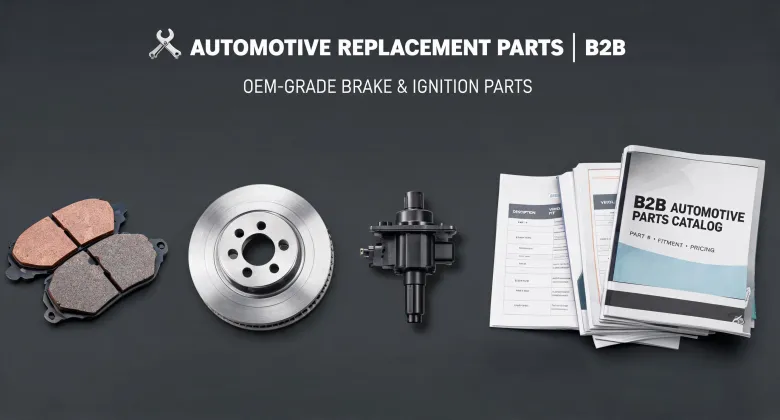
I'm not a sales engineer. I'm the person who looks at the part after a supplier says it's ready. In my role as quality and compliance manager at an automotive metal components plant, I review PPAP files, first-article reports, and material certifications. I've approved parts from both large suppliers and small shops, and I've rejected both.
Direct-replacement parts can look unrelated until you see the pattern. One buyer searches starter bendix price, another looks for a Bendix servo fuel injector, someone asks how does an intercooler work, and someone else wants a wheel bearing part. Different systems. Same decision underneath: validated part or price-first part?
What I compare: validated parts vs. price-first parts
Let's make the comparison explicit. Option A is a part backed by engineering data. Option B is the lowest-priced part that seems to fit. For each component family below, I ask four questions:
- Material traceability: does the vendor know what alloy, coating, and heat treatment were actually used?
- Geometry and tolerance: does it meet the drawing at the critical locations?
- Performance evidence: has the assembly been tested or calibrated?
- Failure cost: what does it cost in labor and collateral damage if this part fails?
Starter Bendix Price: Small Part, Big Engagement Risk
A starter bendix is the pinion drive assembly that slides into the flywheel ring gear when the starter motor spins. Modern versions often include a one-way clutch and spring, not just a gear. Two parts can have the same tooth count and spline, but very different engagement behavior. If the clutch slips under load or the spring doesn't release, a low-price starter bendix can turn a $30 mistake into a $300 flywheel job.
I looked at service prices in early March 2025 for a common small starter drive. I want to say generic replacement kits started around $25 and a documented drive was closer to $75, but don't quote me on the exact catalog numbers—prices move. The point is that the gap exists for a reason. Here is something vendors won't tell you: a visual fit check does not verify case hardness, clutch torque, or spring return timing. Those need test data from the manufacturer.
If the vehicle is a daily driver, I would select the documented drive and treat the difference as cheap insurance. If you are only checking a spare that won't strand anyone, a lower-cost drive may be acceptable, but don't call it equal.
Bendix Servo Fuel Injector: The Calibration Is the Part
Before you use a starter bendix price as a baseline, understand the name difference. A Bendix servo fuel injector is not a starter part. It's a fuel metering unit used in certain piston aircraft and industrial engines. The historical connection confuses people because the starter bendix and the Bendix fuel injection name come from the same engineering lineage. But the products are completely different.
A servo fuel injector meters fuel by balancing airflow force and fuel pressure. The servo movement, internal spring rate, metering bore, and surface finish are all part of one calibration system. That's why a rebuilt unit has to come with a test record or flow check. If the outside looks right but the internal spring rate was changed, the fuel delivery curve will be off in ways an engine monitor might not catch until it's expensive.
I've audited rebuilds where the paperwork said calibrated but no numbers were attached. If a vendor can't provide fuel flow or pressure test evidence, move on. For this part, price-first is not a strategy; it's a gamble.
How Does an Intercooler Work? It's Cooling Plus Flow
An intercooler is a heat exchanger between the turbocharger compressor outlet and the engine intake. The turbo heats the air as it compresses it. Hot air is less dense, so the engine gets less oxygen per cubic foot and is more likely to detonate. The intercooler removes heat before the air enters the engine.
In an air-to-air unit, hot pressurized air enters an inlet tank, spreads through flat tubes or internal passages, and transfers heat to fins. Outside air passing through the fins carries heat away. In an air-to-water unit, engine coolant or a separate water circuit does the same job. That's the simplified answer to how does an intercooler work.
The next question is whether a bigger core is better. No, not by itself. A core that cools well but creates high pressure drop can cost more boost than it recovers. At the same air mass and inlet temperature, one core might lower outlet temperature by 90°F with a 0.6 psi pressure drop. Another might lower it by 70°F with a 2.4 psi drop. The second core feels colder but may reduce net airflow. If someone only tells you the cold side pipe is ice cold, they are missing half of the story.
If you're looking at a PPE intercooler, treat it the way you'd treat any engineered part. The PPE brand may offer a direct-fit cooler for your truck, which removes install guesswork. But I still want to see core size, fin density, and pressure drop data at the airflow the vehicle expects. A comparable no-name product can be fine if it provides the same documentation. If it doesn't, you're comparing shapes, not intercoolers.
Wheel Bearing Part: The Assembly Is What You're Buying
A modern wheel bearing part is often a complete hub assembly, not an individual bearing race. The package can include rolling elements, seals, a mounting flange, wheel studs, and an ABS tone ring or magnetic encoder. All of those parts have to stay concentric while the vehicle rolls and while the driver brakes.
The tone ring matters more than many buyers expect. Tone rings are often stamped metal. If the stamping process drifts, or the ring is pressed at an angle, the ABS sensor sees an uneven signal. In a Q4 2024 audit, I rejected hub assemblies because tone ring runout was about 0.12 mm over our specification. They spun smoothly and fit the bolt pattern. The stability system still might have logged false events. No amount of grease was going to fix that.
When you search for a wheel bearing part, look for the total package and the data behind it. If the supplier can give you runout values, material certifications, and ABS signal test results, price can be compared. If the only advantage is a lower number on the invoice, it isn't enough for a wheel-end safety component.
So Which Do You Pick?
I don't think there is a universal answer. I have approved low-cost parts that had better documentation than premium parts, and I have rejected premium parts with missing evidence. The honest limitation is that the choice depends on the application and on what the supplier puts in writing.
- Starter bendix: choose a documented drive when starter labor cost or tow risk is high. Budget replacements are a reasonable test-bench option, not a daily-driver recommendation.
- Bendix servo fuel injector: do not buy without a calibration or test record. No example of this part is cheap enough to skip verification.
- Intercooler: for a stock daily vehicle, a core with verified fit and low pressure drop is enough. For tuned, high-load use, look for performance data, not just thickness.
- Wheel bearing part: wheel-end components affect ABS and stability control. I lean toward the validated assembly, even when the budget choice is tempting.
So next time someone searches how does an intercooler work or starter bendix price, add one more question: what proof comes with the part? The cheapest part is not the one with the lowest number. The cheapest part is the one that doesn't have to be installed twice.