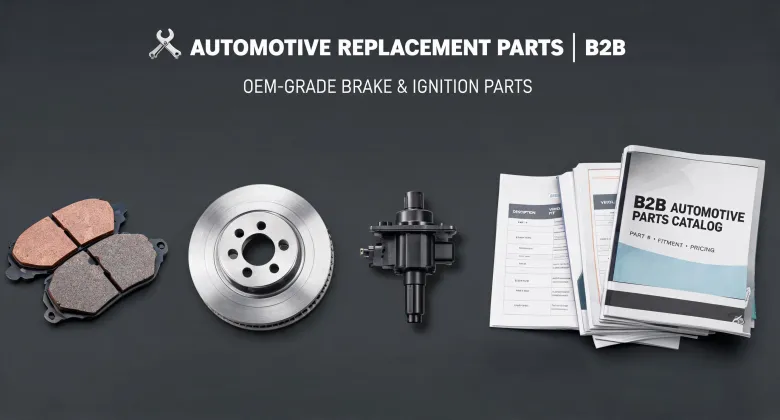
I'm not a mechanic. I'm the person who orders the parts for mechanics. For the last six years, I've handled purchasing for a 45-person automotive repair shop—roughly $1.2M in parts annually across 30+ vendors. I report to both the shop manager and the finance director, which basically means I get to explain why an $80 part ended up costing $400 by the time we were done.
People search for things like "what is a bendix on a starter" or "what does a high pressure fuel pump do" because they're staring at a repair estimate they don't understand. I've had to learn these answers the hard way—through wrong orders, restocking fees, and at least one conversation with my VP I'd rather forget. Here's what I wish someone had explained to me.
What is a bendix on a starter?
The bendix—also called the Bendix drive—is the spring-loaded gear assembly on the starter motor that slides forward to engage the flywheel when you crank the engine. The name comes from Vincent Bendix, who patented the design in the 1910s. When you turn the key, the starter motor spins, the bendix gear shoots up on its spiral shaft, bites into the flywheel teeth, and spins the engine until it fires. Then a spring pulls it back down so it doesn't get shredded at high RPM.
When someone searches "bendix on a starter," they're usually hearing a grinding noise or that high-pitched whine where the engine cranks but doesn't catch. That whine is often the bendix spinning without engaging—the gear teeth are worn, or the spring is too weak to push it forward. Replacing just the bendix drive is possible, but you have to match the exact starter model. We ordered the wrong one twice in 2022 because we guessed by vehicle year instead of pulling the starter's part number first. Both returns cost about $25 each in restocking fees, plus a day of shop time per vehicle. The lesson: remove the part and check before you order. It's boring, but it's way cheaper.
Are bendix rotors brake rotors or something else?
This one trips up everyone, and I mean everyone. "Bendix" is a company name—and yes, Bendix makes brake rotors, pads, and other friction products. But the "bendix" on a starter has nothing to do with rotors. So when someone types "bendix rotors," they're usually looking for brake rotors from Bendix the brand, or they're mixing up words. A customer might have heard "Bendix" during a brake recommendation, then written it down wrong.
Here's the thing: context is key. In our shop, we ask three questions when a parts request is ambiguous: brakes or starter? what year and model? and where did you hear that part name? That sounds kinda basic, but it's saved us from ordering brake rotors for a vehicle that actually needed a starter drive. From the outside, it looks like a simple word search. The reality is that automotive terminology is full of traps where one name refers to two completely different parts.
What is the DEA A2639 transmission mount?
The DEA A2639 is a specific transmission mount part number. DEA makes aftermarket mounts, bushings, and suspension components, and the A2639 references a precise application—certain vehicle platforms with specific engine configurations. Engine and transmission mounts are rubber-metal brackets that hold the drivetrain in place and absorb vibration. When they fail, you feel clunking on shifts, vibration at idle, or a thunk under acceleration.
Part-number accuracy matters more than I ever expected. In 2024, we bought a "universal" mount at half the price of the correct DEA A2639 for a fleet van. The mechanic spent an extra 45 minutes making it work, the driver complained about vibration a week later, and we ordered the right part anyway. When I added labor, removal, and the follow-up appointment, the cheap mount cost us about $190 more than the right one would have upfront. Per FTC guidelines (ftc.gov), claims like "direct fit" or "OE quality" are supposed to be substantiated. We've learned to read vague "universal" wording as a red flag, not a value proposition. And for the record, the metal bracket itself is usually a stamped steel or aluminum extrusion component—so the quality of the metal forming matters just as much as the rubber bushing.
What does "flywheel model" mean when I'm looking up parts?
A parts catalog asking for the "flywheel model" isn't asking for a brand name. It's asking which specific flywheel your engine has—diameter, tooth count, and bolt pattern all matter. The flywheel is the heavy metal disc mounted to the crankshaft that the starter bendix gear bites into. Different engines, even in the same vehicle year, can have different flywheels depending on engine code, transmission type, or production date.
Why does this matter? Because if you order the wrong flywheel, the starter bendix gear won't mesh cleanly. It'll grind, wear out fast, or simply not engage. Now you've damaged the new flywheel and possibly the starter drive as well. I've seen a $180 flywheel mistake turn into a $900 repair once you factor in labor and the second set of parts. Real talk: check the engine code and the VIN's assembly date before ordering anything. It takes two minutes and saves a ton of headache.
What does a high pressure fuel pump do?
Modern gasoline direct-injection engines run fuel pressure way higher than older setups—2,000 to 3,500 PSI at the injector, compared to 40-60 PSI in port-injection engines. The high pressure fuel pump (HPFP) is what creates that pressure. It's usually driven off the camshaft and pushes fuel directly into each cylinder for better combustion efficiency, more power, and lower emissions.
When the HPFP starts failing, the symptoms aren't subtle: long cranking before the engine catches, rough idle, loss of power, and the check engine light. The part itself is expensive—often $600 to $1,200 before labor. I have mixed feelings about cheap aftermarket HPFPs. On one hand, saving $400 on an off-brand pump feels like a win for the customer. On the other, I've seen two low-cost units fail before 20,000 miles, and the labor to replace one is brutal—often four to six hours because of where it sits on the engine. Bottom line: this is a pay-me-now-or-pay-me-later part. In our experience, spending more upfront on a reputable brand is the better total cost decision, even if the initial quote stings.
Is Bendix the company still making starter bendix drives?
This is the question nobody thinks to ask, but it clears up a lot. Vincent Bendix invented the starter drive and founded Bendix Corporation in the 1920s. The company went on to make brakes, fuel systems, and aerospace components. But the "bendix" on a starter is now a generic term—like "kleenex" for facial tissues. When a parts catalog lists a "bendix drive," it's referring to the mechanism type, not necessarily a part manufactured by Bendix the company.
That said, Bendix the brand is still very active in automotive parts. Bendix friction products—brake pads, rotors, and commercial vehicle braking systems—are common choices in the industry. Our shop has standardized on Bendix brake components for fleet customers because fitment has been consistent and we haven't seen the premature wear we got with some budget lines. As for starter bendix drives, we pick based on supplier reputation rather than the name alone. We tested a $15 off-brand drive once; it failed in eight months. The $45 unit from a reputable supplier went four years. That's not brand loyalty—that's just what the spreadsheet said when I compared total cost across both choices.
I can only speak to what's worked in our context: a mid-size repair shop with a mix of fleet and consumer work. If you're running a high-volume distribution operation or sourcing parts for a manufacturing line, there are factors I'm not aware of. But for the basics—what a bendix is, why flywheel model matters, what a high pressure fuel pump does—this should give you a clearer starting point. And the next time someone quotes you a suspiciously low price on a critical part, run the total cost math before you say yes.