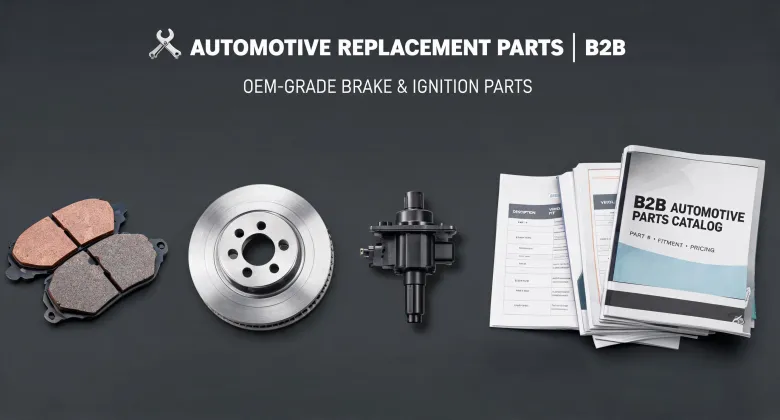
I run procurement for a 40-person auto parts company. Our annual parts and maintenance budget sits at $260,000, and I've been tracking every order in our cost system since 2019. So when I compare 'brake pad installation cost' quotes, I'm not comparing advertised prices. I'm comparing what happens after the invoice.
Here's the thing: brake pad installation cost is the least useful number in brake repair. It's also the number most people ask for first. I'm going to tell you why that's backward, and what to look at instead.
The cheapest brake job is the one that gets paid for twice. The most expensive is the one that isn't actually done.
Quotes Are Not Costs
Most published repair estimates put the average brake pad replacement between $150 and $300 per axle, including parts and labor, based on RepairPal and shop rate surveys as of January 2025; verify current rates in your market. That range is fine for budgeting. It's useless for comparing shops.
An average is not a quote. A quote is not a final invoice. And a final invoice is not the full cost. Period.
Why Low Labor Quotes Usually Cost More
In Q2 2024, I got eight quotes for our delivery vans. The cheapest advertised brake service was $85 per axle. The most expensive was $220. Guess which had the lower total cost? The $85 quote was a labor special. Pads, rotors, hardware, and fluid were all 'additional.' By the time we specified actual parts, the total came to $412 per axle. The $220 quote included brand-name pads and new rotors. Total: $220. The difference wasn't hidden fees. The difference was that the cheap quote was for a half-finished job.
Then we had a $1,200 redo when a low-price shop installed pads so quickly they never cleaned the caliper brackets. The bracket corrosion pushed the pads back, and the rotor warped. The shop offered to 'check it,' but the vehicle was already back in service, and the fault was obvious. We paid a second shop to redo the brakes. That's the cost of a cheap brake job.
The Part Price Is Part of Installation Cost
My second point is simpler. Labor is roughly the same no matter which pads you choose. So the cheapest part is not an installation savings; it's a gamble on when you'll pay the labor again.
Brake pads are friction materials. They convert kinetic energy into heat. A budget pad might use a harder resin that grips okay when cold but fades at high temperature. It can also wear the rotor faster. The first sign isn't your brake light. It's a pulse in the pedal at 75 mph.
The 'all pads are the same' thinking is a leftover from an era when light car brakes were mechanically simple and stopping distances were longer. Today, pad compounds are engineered for weight, heat, and noise. They aren't the same.
How Does a Disc Brake Work? Enough to See Where the Dollars Go
How does a disc brake work? It's a simple system. Step 1: you push the brake pedal. Step 2: brake fluid moves a piston inside the caliper. Step 3: the piston presses two brake pads against a metal rotor. The friction between the pads and the rotor turns the car's forward motion into heat. The vehicle slows.
Nothing else in the system touches the rotor on a fixed interval. The pad is the only replaceable friction surface in that whole loop. So when you cut the pad price from $50 to $20, you're changing the one component that controls how the system slows down. That's not a small decision.
The Same Logic Applies Beyond Brakes
This cost view extends beyond brake pads. It applies to everything I buy. Take a 102mm LS throttle body: a budget unit might be $180, and a name-brand unit might be $260. The bore is the same. The casing looks identical. But the position sensor and blade alignment are not the same. Four weeks into a build, the cheap one was reading a hunting idle. We paid labor again to swap it. The extra $80 was the insurance to avoid the $350 labor charge.
Same with starter gears. A Bendix starter gear is a specific design with a pinion that engages the flywheel. The generic equivalent can look right in the box. But a starter that kicks out too early grinds. You don't notice until the flywheel is damaged. Then the repair isn't a part replacement. It's a flywheel, a starter, and labor.
And if you think I'm exaggerating component failures, consider the Bendix engine cooling fan clutch solenoid K073075. That's a specific replacement part for a fan clutch. A generic solenoid can be 40% less expensive. But if it fails, the fan clutch doesn't engage. The engine can overheat. When we tested a generic one in 2023, it lasted 38 days. The replacement with the Bendix solenoid was more, and it took the guesswork out. I learned that lesson the expensive way: a $600 tow, a $1,150 head gasket repair, and a vendor that stopped answering the phone.
Counterargument: Sometimes Cheap Is Fine
Let me answer the obvious objection. There are times when a cheap part is the rational choice. For a low-power, low-speed vehicle that sees light use, a budget pad might reach its wear interval. I've approved budget parts when the use case fit. I'm not saying every dollar more is better. I'm saying price alone doesn't tell you which use case you're in.
People think expensive vendors deliver better quality because they charge more. That's backward. Vendors who invest in test data, material certification, and warranty support can charge more because the evidence costs something. The price is the result of the investment, not the cause of the quality. When I see a quote that is 30% lower without a spec sheet, I hear 'we skipped a step' — or at least, I did after the first time it bit us.
What I actually want from a shop or parts supplier is simple:
- Brand names and part numbers on the quote.
- A labor line item that says what's included (pads, rotors, slide pin service).
- An explicit answer on whether the rotors are being machined or replaced.
- Whether brake fluid replacement is part of the service.
If a quote doesn't answer these, that's not a deal. That's a mystery with a wheel count.
Stop Comparing the Wrong Number
So after six years of purchase data, here's my conclusion. Brake pad installation cost is an input, not an outcome. The outcome is how many miles the vehicle stays safe and how much the next repair costs. If you compare only the quoted price, you'll make decisions that look good in the spreadsheet and cost money in the shop.
Buy the part that has a name, a spec, and a warranty. Pay the labor that includes the whole job. And remember that 'how does a disc brake work' is a question worth understanding, because the answer tells you what's actually bearing the load.
That's been true for brake pads, for a 102mm LS throttle body, for a Bendix starter gear, and for the Bendix engine cooling fan clutch solenoid K073075. One failed component can erase a year of savings. I've seen it. I've got the invoice.