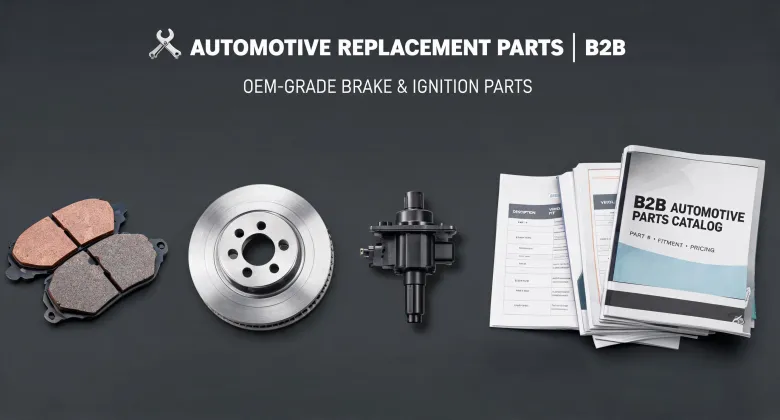
Ask anyone in automotive procurement what their goal is, and they'll say "savings." I used to say the same thing. Six years and $180,000 in tracked parts spending later, I've changed my answer—and it's cost me a few arguments with my own spreadsheets to get here.
Here's my position, stated plainly: the cheapest automotive part is usually the most expensive decision a procurement team can make. Not because cheap parts always break. Because they change how customers perceive your quality—and that perception arrives on the balance sheet as rework, warranty expenses, and lost trust.
I'm a procurement manager at a mid-sized automotive components supplier. I manage a parts budget around $30,000 a year, have negotiated with 20+ vendors, and documented every order in our cost tracking system. What I want to share isn't a lecture about spending more. It's an argument for understanding what "saving money" actually means.
The part that changed my view
Back in Q3 2023, I approved a switch to an unbranded alternative for the Bendix steering angle sensor. The price was 30% lower. The dimensional specs matched. The connector pinout matched. The supplier's test reports looked fine. I signed the purchase order and moved on.
Three months later, field data showed something else. About 4% of the sensors drifted out of calibration during thermal cycling. On a vehicle, that means the electronic stability control sometimes receives inaccurate steering wheel position data. There's no diagnostic code. No warning lamp. The car just feels... unstable at highway speed. Drivers can't explain what's wrong. They just know the vehicle doesn't feel right.
When I compared those field reports against the Bendix units running on the same platform, the difference was obvious. The unbranded sensor had a failure mode that incoming inspection could never catch—and it showed up as a perception problem that no warranty policy can fully repair.
That's when I got the point: quality perception doesn't require a product to fail. It only requires doubt.
And doubt is enough to lose a fleet customer.
Brake master cylinders: where "cheap" stops making sense
I had an even harder conversation about a Bendix brake master cylinder alternative. A distributor offered me a "comparable" master cylinder at 40% below the Bendix unit. My cost-saving instinct said yes. My total cost of ownership spreadsheet said slow down.
Here's what the math looked like: a typical master cylinder replacement runs $300–$500 in parts and labor for a sedan (based on quotes I gathered from three service centers in January 2025; rates vary by region and vehicle). That's a repair bill. But a master cylinder failure can mean reduced brake pressure—or a pedal that sinks to the floor. That's not a service visit. That's a safety incident.
Brake systems sit under strict regulatory oversight in most markets. In the U.S., FMVSS 135 establishes performance requirements for hydraulic brake systems, and brake-related problems regularly appear in NHTSA recall data. The point isn't that every affordable master cylinder is defective. It's that the cost of being wrong in this product category is disproportionately severe. Saving $120 on a master cylinder is a terrible trade when the failure mode involves a driver's ability to stop.
I passed on the deal. I'd rather pay the 40% premium and sleep at night.
The same logic applies to "minor" parts
It's tempting to think that smaller components—like the Mopar 56041698aa oxygen sensor—don't carry the same risk. They're easy to swap, cheap to replace. So why spend twice as much?
Because I've paid that difference in diagnosis hours. In 2024, I sourced a universal aftermarket oxygen sensor for a fleet of FCA/Stellantis vehicles instead of the OEM Mopar part. On paper, both sensors met the same fundamental parameters. In practice, the universal unit's signal response curve didn't match the engine control strategy's expectations. The ECU kept throwing P0138 codes, and we burned through three "working" sensors in five weeks, plus the tech hours to install and reinstall each one.
The most frustrating part of that episode: each individual swap seemed to fix the car, and the code came back days later. You'd think a spec sheet labeled "O2 sensor, universal" would be enough, but it didn't capture the signal-processing quirks of that particular ECU.
So glad I finally switched to the OEM part. Almost kept chasing the $60 saving per unit—which would have meant a fourth round of diagnostics and a service manager who was one comeback away from reporting me to my boss.
Actually, that's not quite the whole story. The same vehicles also had a catalytic converter concern, and a technician suggested an Oxicat catalytic converter cleaner as a maintenance step. I was skeptical—honestly, I still don't think any additive is a substitute for replacing a physically failed converter. But the diagnostics showed the substrate was intact, and the issue was more about accumulated deposits and a minor efficiency code. A converter replacement runs $800–$1,400 for the platforms I handle (labor included, based on January 2025 market rates). The Oxicat treatment cost a fraction of that, and it resolved the stored code without a warranty-level intervention.
I'm not here to sell additives. I'm here to point out the pattern: even in maintenance products, customers are buying confidence, not just chemistry. A recognized name like Oxicat gives a service advisor and a vehicle owner a path before the expensive replacement. That's perception management with a practical outcome.
What does a crankshaft sensor do?
And that brings me to a question I hear from junior buyers regularly: what does a crankshaft sensor do? It monitors the rotational speed and position of the crankshaft, sending that signal to the ECU so it can time ignition and fuel injection. If the sensor fails, the engine loses synchronization—crank but no start, or a stall at the worst possible moment.
The procurement angle? A cheap crankshaft sensor can pass every bench test and still misbehave under engine heat. The waveform degrades, the ECU gives up, the vehicle dies. This is exactly the kind of intermittent failure that customers blame on the vehicle brand—not the part number. And that, in one sentence, is why quality perception matters.
But what about the budget?
I hear the objection constantly: "I don't have the freedom to pay more. My targets are built on cost savings." To be fair, I was in that seat for years.
But after six years of tracking invoices, my data says the math isn't what it seems. In Q2 2024, I audited two sourcing strategies across similar order volumes. When we used recognized brands, rework costs fell 31% and emergency orders dropped by nearly half compared to the low-bid period.
Hmm, let me correct that before someone calls it out. The 31% held up. The emergency-order number was closer to 38% once I annualized it—still dramatic, but I don't want to overstate.
Granted, this approach requires more upfront work. It means building a TCO model, getting leadership to approve a budget line for "quality confidence," and sometimes defending a purchase order that looks more expensive on paper. But it changes the conversation from "what did we save this quarter?" to "what did this component cost over its full lifecycle?"
That's not a downgrade in procurement discipline. That's a promotion of it.
I still require three quotes minimum for any significant component, and at least one of those quotes has to come from a brand with a reputation to protect. Not because the brand always wins—but because comparing it against the alternatives forces an honest conversation about what the price difference actually buys.
The bottom line
Looking back, I should have built quality perception into our sourcing policy years earlier. At the time, I saw brand premiums as wasted margin—a luxury for teams with larger budgets. I've since learned that quality perception is not a luxury line item. It's a cost control metric.
I'll happily pay a 15–20% premium for components that protect our customers' confidence in their vehicles. That's not ideology; it's arithmetic. Whether it's a Bendix steering angle sensor, a Bendix brake master cylinder, or the exact OEM part number a vehicle was designed around, the brands that have earned trust deliver something measurable with every unit: fewer surprises, fewer comebacks, and fewer quiet conversations about a part that made someone think less of the vehicle.
I've tracked everything we've spent. The most expensive mistake I ever made was saving money on parts that carried the weight of a customer's perception.
If you're sourcing automotive components, put quality perception in the spreadsheet—next to price, lead time, and payment terms. It's the hardest line item to see in the moment, and the easiest one to prove after the fact.