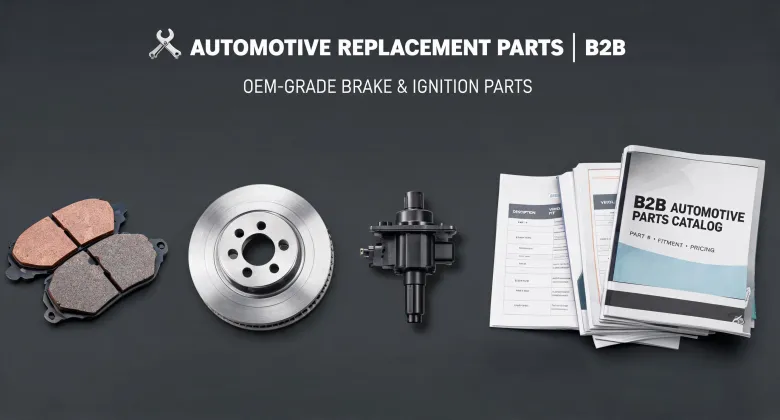
There's no single 'best' brake pad, rotor, or filter for every vehicle. I learned this the hard way — through roughly $8,000 in rework and replacement costs over my first five years in the shop. The problem is that most advice online treats all cars the same. A 2010 F150 towing a trailer needs completely different parts than a sedan used for city commuting. And the cheapest option? It's almost never the most affordable in the long run.
Here's what I've learned, organized by the three most common driving profiles I see. Find yours, and you'll know exactly what to look for — whether you're buying a Bendix SBC1202 Stop by Bendix brake pad set, evaluating Bendix rotors reviews, or deciding how often should you change your engine air filter.
Scenario A: The Daily Commuter / Light-Duty Driver
You drive mostly on paved roads, stop-and-go traffic, and rarely carry heavy loads. This covers about 60% of the vehicles I service.
Brakes: Pads and Rotors
For this group, Bendix SBC1202 (semi-metallic, moderate dust) is a solid pick. I've fitted these on dozens of sedans and crossovers. They bite well when cold, last 40,000–50,000 miles, and won't chew through rotors. But — and this is important — don't pair them with Bendix rotors that are drilled or slotted unless you track the car. Those rotors cost more and wear pads faster. I once put a set on a Honda Accord thinking they'd look cool. The pads wore out 12,000 miles early. Cost me $180 in replacement plus the rotor wear. Stupid move.
Personal rule: For daily drivers, use solid Bendix rotors (no holes, no slots). You get longer pad life and less noise. The Bendix rotors review I'd give: 4.5/5 for daily use, 3/5 if you expect race-car braking.
Oil Filter: 2010 F150 Example
The 2010 F150 oil filter is a common item. Many shops push the cheapest filter ($4–6). In my first year, I used one on a customer's truck. The filter collapsed at 5,000 miles, starved the engine of oil, and cost the customer $1,800 for a new short block. I still kick myself for that.
Now I only use OEM-grade or premium aftermarket filters (like Bendix's own line). For the F150 5.0L V8, that means a filter with a bypass valve set at 10–13 psi and a synthetic media. Yes, it's $12–14 instead of $5. But the peace of mind is worth it — especially when you see the metal shavings that cheap filters let through.
Air Filter: How Often to Change
Here's a misconception I see all the time: "Every 30,000 miles." That was true 15 years ago when air filters were paper-and-cardboard. Today, with synthetic media and variable driving conditions, you really need to check it. For a daily driver in a non-dusty area, I change mine every 15,000 miles — or earlier if I notice a drop in fuel economy. For a 2010 F150, the owner's manual says 30,000 miles. That's conservative. I'd say how often should you change your engine air filter? Probably 15,000–20,000 miles in real-world driving. I learned this after a customer came in with a plugged filter at 25,000 miles; the MAF sensor was fouled, costing $250 to clean. That extra $15 filter would've saved the trouble.
Shock Absorbers: The French Connection
You mentioned amortisseur shock absorber. I get a lot of questions about how to choose shocks for older European cars. On a daily driver, you don't need high-performance gas shocks. A standard twin-tube shock like Bendix's OEM replacement line works fine. But here's the mistake: many shops replace only one axle because the other one "looks fine." Always replace in pairs. I once replaced just the front shocks on a 2010 F150. The rear ones were original with 120,000 miles. The truck handled horribly — it would dive under braking. I had to redo the rear a month later. Wasted $150 labor. Now I insist on axle pairs.
Scenario B: The Heavy-Duty / Towing / Fleet Vehicle
If you regularly tow a trailer, haul equipment, or drive a service van, your maintenance intervals shrink. This applies to fleet managers and owner-operators who care about total cost of ownership — not just the sticker price.
Brakes
Stop-and-go with a load generates heat that destroys semi-metallic pads. I've seen Bendix SBC1202 pads last only 20,000 miles on a work van. For heavy use, step up to a ceramic or heavy-duty semi-metallic compound. Bendix makes a 'Heavy Duty' line — the SBC1202 isn't that. Check the box. If it says 'Stop by Bendix brake pad set', that's for passenger cars. I learned this when a customer's F150 with a slide-in camper came back with glazed pads after one summer trip. The set was wrong for the load.
Bendix rotors review for heavy use: their standard rotors are fine for occasional towing, but for frequent heavy loads, get them with a thicker rotor (like the 'Duralife' line). I've seen standard rotors warp after 15,000 miles of towing. The upgrade costs about $40 more per axle but lasts 50,000+ miles.
Oil Filter & Air Filter
For a 2010 F450 chassis (or any heavy truck), change the oil filter every oil change — obviously. But the air filter needs closer attention. In dusty construction sites, I've seen them clog in 5,000 miles. The rule of thumb: if you can't see light through it when held up to the sun, replace it. For heavy-duty, I change every 10,000 miles or when the restriction gauge says so. How often should you change your engine air filter in a fleet? I'd say every oil change for severe service. The $20 filter saves a $300 MAF sensor and keeps fuel economy up.
Shock Absorbers
The amortisseur shock absorber on a heavy-duty vehicle needs to dissipate more energy. Don't cheap out. A basic twin-tube shock will fade after 20 minutes of highway towing. I recommend a monotube gas shock for any vehicle that carries over 70% of its GVWR. The upgrade adds maybe $30 per corner, but it controls body roll and prevents premature tire wear.
Scenario C: The Budget-Constrained / Older Vehicle
Sometimes the car isn't worth a lot, and the owner just needs it to pass inspection for another year. I get it. But even then, 'the cheapest option' can backfire.
Brakes
For a 2010 F150 with 200,000 miles, you might be tempted to buy the $20 brake pad set. Don't. I've seen those pads delaminate after 10,000 miles. Use a moderate semi-metallic like Bendix SBC1202 — even for an old truck. It's $35 instead of $20, but you won't have to redo the job in six months. And check the rotors: if they're below minimum thickness, replace them. I once turned a set of rotors that were already thin, and they warped after 3,000 miles. The customer paid for labor twice.
Air Filter & Oil Filter
On a budget build, oil filter quality matters. I've seen cheap filters let debris bypass and score bearings. Use a mid-range filter (like Bendix's line) for $8–9. For the air filter, if the car burns some oil, a dirty filter makes it worse. Change it at 15k miles — that's still cheap insurance.
How to Tell Which Scenario You're In
Be honest about your driving:
- Daily commuter: Less than 12,000 miles/year, no towing, mostly pavement. → Go with Scenario A recommendations.
- Heavy-duty: Towing > 5,000 lbs payload, fleet service, off-road, or commercial. → Follow Scenario B.
- Budget/High-mileage: Vehicle has > 150k miles, you plan to keep it < 2 years, minimal investment. → Scenario C can work, but don't overspend on the cheap stuff.
One more thing: Bendix rotors review from my experience — their standard line (non-slotted) gives the best bang for the buck for 80% of drivers. The premium line is for those who need extra heat capacity. Don't buy the premium rotors thinking they'll make your car stop faster; they won't.
And if you're looking for bendix sbc1202 stop by bendix brake pad set, check your vehicle weight first. If it's over 6,000 lbs GVWR, consider the HD version. That's a mistake I made twice before I learned to read the fine print.
Look, I'm not saying Bendix is the only brand you should consider. But after all the rebuilds and re-dos I've seen, I'd rather pay for quality up front than pay more later. The value over price approach has saved my customers — and my own shop — thousands of dollars. Next time you're tempted by the $4 oil filter for your 2010 F150, ask yourself: is that $4 saving worth the risk of an engine failure? Probably not.