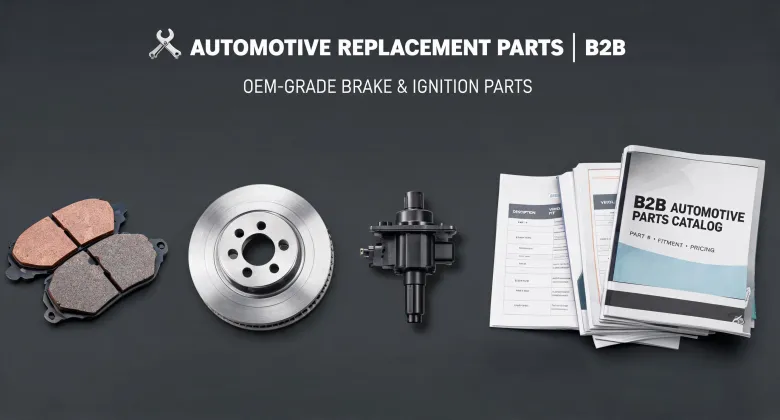
Here's the thing about sourcing automotive parts like bendix brake components or a starter bendix gear: what worked for a fleet maintenance facility is different from what works for a dealership's service bay. And neither is the same as ordering parts for a specialty shop that sees a Maserati Ghibli once a month.
I manage purchasing for a mid-size service center — roughly $150,000 annually across eight vendors. When I took over procurement in 2023, I thought buying parts for the shop would be like buying office supplies: get specs, find the lowest price, order. I was wrong.
Let's break this into three common scenarios I've seen. Your situation might match one of these.
Scenario A: Standard Replacements (Rotors, Bearings, Gears)
This is where most of my orders fall. You need a bendix brake rotor for a standard passenger vehicle, or a worn out wheel bearing on a fleet truck. The part numbers are known, the fitment is predictable, and you're replacing with OEM-spec parts.
For these orders, my approach is simple: verify the bendix brake rotor minimum thickness spec against the manufacturer's recommendation first. I've had vendors quote me a bendix rotor that was borderline for the application — technically correct for the vehicle but too thin for the customer's towing needs. Checking that spec upfront saved me a warranty claim.
In this scenario, I order from our established vendor for bendix parts. They know we value invoicing clarity and accurate shipping. The process is routine. But here's the catch: even for standard parts, don't assume the starter bendix gear you're ordering is the right one. I once ordered what I thought was the correct part for a Ford F-150, based on the year and model. The gear engaged but the teeth didn't mesh perfectly. It was a close match — close enough that a less experienced buyer might have installed it. The vendor took it back (note to self: verify gear tooth count, not just model year).
Scenario B: Emergency Repairs (Radiator Bleeding, Bearing Failure)
The phone rings. A technician just discovered a worn out wheel bearing on a customer's car, and the customer needs it back by end of day. Or someone needs how to bleed a radiator in a car explained, and the shop realizes they're out of the proper tool.
Emergency orders are a different beast. Price matters less than speed. I've learned to accept that rush sourcing means higher costs — sometimes 30-50% more for a bendix brake rotor if I need it same-day from a local supplier.
But I also learned the hard way: during a rush, document everything. The vendor who rushed me a starter bendix gear charged a premium but couldn't provide a proper invoice. Finance rejected the expense. I ate $340 out of my department budget. Now I have a pre-approved list of emergency vendors who can provide proper documentation on rush orders.
For how to bleed a radiator in a car consumables (coolant, bleed kits, funnels), I keep a small stock of the common items we use. It's a simple buffer: $50-100 of inventory that prevents most emergency orders. That's saved us about 8 hours of emergency ordering time monthly.
Scenario C: Specialty Vehicle Parts (Maserati Ghibli Oil Filter, Custom Applications)
This is the tricky one. Customer brings in a Maserati Ghibli oil filter replacement. The OEM filter is expensive, and aftermarket options are limited. I can't just pull from our standard bendix catalog and assume it fits.
My experience is based on about 40-50 specialty part orders over two years. If you're working with exotics or high-performance vehicles regularly, your calculus might be different. But for occasional specialty orders, here's my rule: accept that you don't know everything.
The vendor who said "we don't stock Maserati filters specifically — here's the OEM cross-reference, and I'd order from this distributor" earned my trust. They admitted their professional boundaries. I'd rather work with a specialist who knows their limits than a generalist who overpromises.
Most buyers focus on finding the part number and price. They completely miss the fitment verification step for specialty applications. The question everyone asks is "what's your best price for a Maserati oil filter?" The question they should ask is "what's the cross-reference source you're using, and can I verify it against OEM specs?"
In this scenario, I'm okay paying 20-30% more for a distributor who can provide verified fitment data. The reprint cost of getting the wrong Maserati Ghibli oil filter — plus the service hour wasted — is far higher.
How to Know Which Scenario You're In
Here's a practical framework I use:
- You're in Scenario A if: the part is a standard replacement for a common vehicle, you've ordered it before, and the timeline is normal.
- You're in Scenario B if: the customer is waiting, the vehicle is already in the bay, and the part isn't in stock.
- You're in Scenario C if: the vehicle is non-standard (luxury, exotic, modified), you can't find a clear cross-reference, or the part requires verification beyond what your catalog shows.
Processing 60-80 orders annually across eight vendors has taught me that the part number is only half the story. The other half is understanding your context. A bendix brake rotor minimum thickness spec matters differently for a commuter car than a tow vehicle. A starter bendix gear for a 2020 model might not fit a 2021, even if the engine is the same.
My advice? Build your vendor relationships around scenario awareness. Tell your primary bendix vendor about your mix of work. They'll likely offer better support for your standard orders (Scenario A) if they know you're not expecting emergency pricing for routine replacements. And keep a separate list of emergency suppliers (Scenario B) and specialty distributors (Scenario C) — paying a premium for the right service is fine, as long as you've verified their invoicing and fitment capabilities beforehand.
And next time you're checking how to bleed a radiator in a car and realize you're out of fluid, you'll know exactly which scenario you're in — and who to call.